Future proofing, it is one of the many reasons why IACS began its apprenticeship.
But, as a business, we knew that this journey was not just about having more people entering our industry. It was about being focused on having the right people, with the right skills to provide support now and in the future. It was about developing a new generation of pipeline inspection and a new generation of inspectors!
This is why we integrated hydrogen into our thinking from day one. It was more than an agenda point. As a business that holds people at its core, and with such a strong reputation for safety, we wanted our colleagues to understand hydrogen and how to work safely with it.
This is why we forged a partnership with Hydrogen Safe, a training business that was integral to our ‘Practitioner in Pipelines for Hydrogen and Utilities’ (PIPHU) curriculum. When PIPHU launched, Hydrogen Safe was one of our strategic training partners.
Then, in the summer of 2025, after seeing first-hand how the team operated, we acquired the company, and they became a part of the IACS group of companies.
Here we talk to Elizabeth Simon, Director of Partnerships, to find out more about her role, why hydrogen and how this will impact on several leading industries.
Can you describe your role in just a couple of sentences?
My role spans several areas including operations, partnerships, business and product development, which is why it is so exciting.
Day-to-day I oversee the business activities, manage our team of instructors, and liaise with the IACS board to strategise and inform on upcoming priorities and planning.
Within partnership development, this is very much about being a part of the major events and initiatives that are taking place within our industry. I attend and participate in conferences including involvement in workshops, panel discussions, webinars and keynotes.
Business development is very much focused on establishing relationships, managing partners and generating revenue, while also identifying new business opportunities.
Finally, product development. I work with our team of instructors and content developers to align new provision with industry and education needs. As an industry that is developing at pace, this is constantly evolving.
Why is it important for more people to be able to work safely with hydrogen?
It is about safety, education and reputation.
We must keep people safe. By helping people to work safely with Hydrogen, we can help to avoid accidents and incidents. If accidents were to occur, this would have a detrimental impact on public perception.
By educating and breaking down misconceptions, we are supporting the reputation of hydrogen and that of the businesses working with it.
Who should be prioritising this training?
We look at our training in three critical areas: introductory, safety and education.
Introductory training is for decision-makers and enablers of the hydrogen economy. This is for the public and local employers to show them the potential of hydrogen for the area of expertise.
This is also about raising public awareness and acceptance. Unfortunately, there are a lot of widely established misconceptions of the safety of hydrogen. Through our training we educate and inform, which goes some way to addressing this.
Our safety training is imperative for contractors, constructors and those who require a competent workforce.
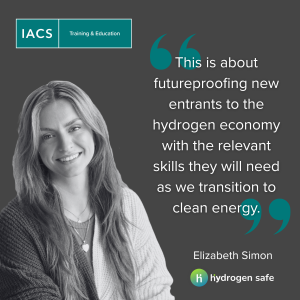
Finally, we have education. Here we support staff with key skills development. This is about futureproofing new entrants to the hydrogen economy with the relevant skills they will need as we transition to clean energy.
How do businesses choose the best HS training course?
For those who immediately recognise a need for training, they can visit our website to find out more. Here individuals and businesses can see which of our programmes is right for them.
For individuals and businesses just starting out on their hydrogen journey, our Hydrogen Skills Framework outlines what jobs are likely to change and to what level, businesses can use this as a toolkit to develop a skills plan for staff.
Our framework is insightful. It really helps individuals to understand what skills they will need. For business it details where their priorities should be when considering the future.
How do you make the training accessible and relevant to the businesses you work with?
All our content is industry-led, so relevant to the businesses that are requiring skills.
What are the biggest misconceptions when it comes to hydrogen?
Without doubt, the safety of it.
If the appropriate health and safety considerations are implemented in an employer’s risk and compliance management and the correct personnel are trained to the appropriate level, hydrogen is no more ‘unsafe’ than any other molecule-based fuel.
What we also need to be consider is that hydrogen has been used for more than 100 years!
How is the hydrogen landscape changing?
It really is difficult to know where to start with this question. It is hugely changing. New technologies are emerging all the time, which is important as this is what will drive down the costs, which are currently high.
Excitingly, there is new funding available, which is certainly helping industries embrace the opportunity.
As an example, through government there is Innovate UK and Hydrogen and Carbon Capture Skills Accelerator programmes.
Business models are also emerging to support companies on how to generate revenue for those entering the value chain.
What do these changes mean for employers?
Put simply, lower costs. Opportunities are more commercially viable, and in many instances incentivised.
What do these changes mean for employees?
Futureproofing them for a changing economy. It is not just about skills for today but tomorrow too.
What are your standout moments, so far, with regards to Hydrogen Safe’s journey?
There are lots! From our ability to educate and inform about Hydrogen, which plays a role in dispelling the myths, through to helping individuals and organisation on their hydrogen journey.
From an inclusivity and diversity perspective, we are proud to be playing a role in highlighting women in STEM careers. Not least through my own role at Hydrogen Safe, and Laura Hewitt, who is co-owner and Director at IACS; and not let us forget the number of women that are embarking on our Hydrogen Safe training.
As an example, IACS’ female apprentices were not only the first within the role of pipeline inspection but also some of the first to attain the Hydrogen Safe qualification.
HS supported the IACS apprenticeship, delivering training to the apprentices - are your programmes suitable for individuals at all levels of an organisation?
We have a range of levels to cater for all individual needs ranging from foundational, intermediate, practitioner to expert. We also develop bespoke modules depending on clients’ needs to ensure it is all relevant to a business and its activities.
What programme did the IACS apprentices complete?
Level 1 Hydrogen Safety Practises Award.
Why did this programme support the IACS brief?
This programme provided apprentices with an award that gives them a government recognised qualification in hydrogen safety.
This means that they have a better understanding of hydrogen properties and how it reacts with pipelines, giving them more capabilities to inspect on pipelines that are transporting hydrogen. This is crucial, especially when we consider the emerging plans.
Time to think to the future
If you have not considered the future with hydrogen, then now is a good time. To start check out the Hydrogen Safe Skills Framework.
Through the Hydrogen Safe website, you can also see what courses, qualifications and bespoke modules are available for individuals, businesses and educators. Importantly, you will also see how Hydrogen Safe is adding value to businesses and individuals from several industries across the UK.